
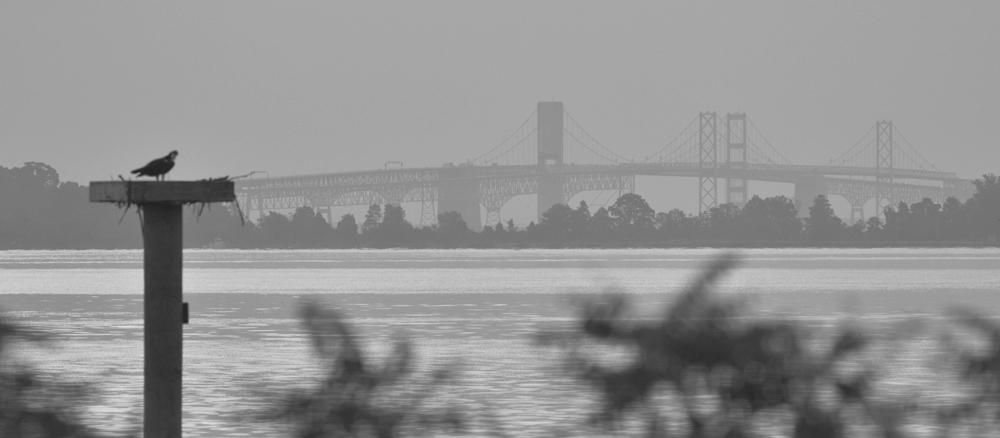
I’ve put together a slide show of the birds and terrain at Wooton’s Landing, along with some general tips about birding the park.
You can see it here: Birds of Wooton’s Landing
Canada Warbler at Jug Bay Wetlands Sanctuary
I was determined to get to Jug Bay again, as they only open early on Fridays. The gate keeper was 10 minutes late, but it all worked out.
The light was lousy once again, but my trusty flash and the magic of Photoshop saved some otherwise poor shots (Making them merely lousy).

Not a great image, but it’s my first one.


With just a little more light these Forster’s Terns would have looked pretty good.

Red Eyed Vireos once again dominated the treetops.

I got quite close to this Great Blue Heron because he was preening.


These are probably young Wood Ducks.


This Indigo Bunting was the only bird who posed in full sunlight.
Prairie Warbler at Wooton Wetlands Preserve
I awoke to a gloomy, cloudy day with a wet sidewalk and ugly skies. Still, the weatherman promised a sunny day, so I left later than usual and the day turned out well. I had an early encounter with a warbler, and a few other decent birds were around, but still no significant migrants.

This Blue Grosbeak was a little distant, but I’ll take it.

There are many White Eyed Vireos at Wooton, but they seldom show themselves.


I haven’t seen a Prairie Warbler in a while, so it took a wile to ID this guy.


I saw several Great Crested Flycatchers today.


Osprey fish regularly in the small ponds at Wooton.


Flycatchers are very active at Wooton, including the Eastern Phoebe.
Frogs and Spiderwebs at Governor Bridge Natural Area.
I arrived around sunrise again, and the weather was an improvement over yesterday, with the fog clearing much more quickly.
Unfortunately, there were no birds to see. It was unusually slow, with only a few sightings. Graeme showed up around 8:00 and we went to a new area of the park in hopes of finding some warblers, but it was not to be.

There were dozens of these little frogs in the puddles.

This Great Blue Heron may have been laughing at us.

This Spider Web was an interesting sight.

This Indigo Bunting.was one of the very few interesting birds we saw.
A Foggy Day at Wooton Wetlands Preserve
The fog rolled in as promised, but, armed with optimism, I arrived at Wooton just about sunrise.
It was eerily quiet, and lots of small birds were active, and it looked promising. The fog lasted longer than I would have wished, and a couple of images would have been much better without it.

I don’t often get this close to a Belted Kingfisher, so it’s a shame the light wasn’t better.

A lovely sight, but not so good for photos.


They’re not birds, but Cicadas are interesting.


This Flycatcher may be an Eastern Phoebe.


I’m seeing some nice females recently, but I’d really like to see a good male American Redstart .

Red Eyed Vireos are foraging everywhere I go.


The light was much better by the time I found this Blue Grosbeak.
Slow Birding and Poor Light at Wooton Wetlands Preserve
There was a report of some possible good birds at Wooton, so Emily and I arrived early, but didn’t have much luck.
Poor light and a distinct lack of birds made for a slow morning indeed.

Emily, in action.


Ruby Throated Hummingbirds seem to be active everywhere.


There wasn’t enough light for this Great Blue Heron, so I played with it a bit.
Broad Winged Hawk at Governor Bridge Natural Area
Although the weather was near perfect again (A few clouds), I’m a little disappointed in the lack of migrating birds. Still, I got a few good images, and was amazed at the numbers of Red Eyed Vireos busily feeding alongside the Gnatcatchers.
The Broad Winged Hawk showed up just as I was leaving, and is a first for me.


This Broad Winged Hawk was being pursued by a pair of diminutive Barn Swallows.


Ruby Throated Hummingbirds will be migrating very soon, and I’ll have to find another bird to harass.

A distant look might confuse a Hummingbird Clearwing with a hummingbird.


Although they breed here, this American Redstart (Female) may be a migrant.


Blue Gray Gnatcatchers were everywhere in the park.


That’s a very tasting looking meal this Red Eyed Vireo has captured.

I appreciated the nice pose offered by this female Blue Grosbeak.

I’ve seen a lot of Eastern Towhees. but very few females.


The “Scrap of sky with wings” known as the Indigo Bunting.will be leaving us soon.
American Redstart at Governor Bridge Natural Area
I met my friend Emily at Governor Bridge early this morning, and we spent 3 or so hours looking hard for migrants without finding much. I believe she got a Magnolia Warbler, but I had to settle for the usual suspects, ‘though the Redstart was a nice find.I spent some more time chasing Hummingbirds, with satisfactory results.


While not as striking as her mate, the female American Redstart is quite beautiful.


The excellent light allowed me to use a shutter speed of 1/4000 for the flight shots.


Hummingbird Clearwings are still feeding right alongside the Ruby Throats.

Emily and I spent half an hour trying to coax this White Eyed Vireo to pose.

Indigo Buntings are especially captivating in good light..


This may be the same Brown Thrasher I saw yesterday.

Red Eyed Vireos tend to be very active in the morning.


This Robin posed nicely amidst the berries.

This Chickadee popped right into the viewfinder.
Blackburnian Warbler at Governor Bridge Natural Area
This was the kind of days birders live for. Not only did I get a life bird, but the light was perfect and the temps were just right. I often spend considerable with Photoshop to get an image just right, but many of these are virtually untouched. I probably won’t have time to get them all up tonight.


I’m nearly 70 years old, but I was as excited as a child to see this beautiful migrant.
Cornell:”A bird of the coniferous forests of the Northeast, the Blackburnian Warbler is breathtaking in its brilliant orange-and-black breeding plumage.”


I found another place where a pair of Ruby Throated Hummingbirds were feeding regularly.


Wikipedia:”Hemaris thysbe, or the Hummingbird Clearwing, is a moth of the Sphingidae family. It lives in Alaska and the Northwest Territories south through British Columbia to Oregon; east through the Great Plains and the Great Lakes area to Maine and Newfoundland; south to Florida and Texas.
Hemaris thysbe or Hummingbird Clearwing Moth
Adults are frequently mistaken for hummingbirds or bees because of their fast-moving wings and coloration. They have a two inch wingspan.
The caterpillars eat viburnum, hawthorn, honeysuckle, and a few types of fruit trees.”


This juvenile Baltimore Oriole was literally crashing through the brush in search of insects.

Brown Thrashers are usually skittish, but this guy stayed in place for quite a while.

These birds will be heading South soon, and I’ll miss them.


Cornell:”The all-blue male Indigo Bunting sings with cheerful gusto and looks like a scrap of sky with wings. Sometimes nicknamed “blue canaries,” these brilliantly colored yet common and widespread birds whistle their bouncy songs through the late spring and summer all over eastern North America. Look for Indigo Buntings in weedy fields and shrubby areas near trees, singing from dawn to dusk atop the tallest perch in sight or foraging for seeds and insects in low vegetation.”


Red Eyed Vireos were easy to find today.


Not a great image, but I haven’t seen a Red Shouldered Hawk in a while.

Blue Gray Gnatcatchers were also easy to find today.
Red Eyed Vireo at Governor Bridge Natural Area
It looked a bit cloudy this morning, and it was considerably cooler than yesterday, so I grabbed a long sleeved shirt before leaving the house.
By the time I arrived, the shirt wasn’t needed, and the clouds had nearly disappeared. A near perfect weather day. The birds weren’t as cooperative, and I spent too much time with the Hummingbirds again, but I’ll settle for what I got.


I’m fond of the Red Eyed Vireo because it took me so long to get a decent image when I was beginning last year.


It’s my Blog, and I can post as many Ruby Throated Hummingbirds as I want.


Indigo Buntings often cooperate better than other birds. .

Catbirds may be the most common bird at Governor Bridge.

I’m not sure which Flycatcher this is.


Blue Gray Gnatcatchers are small and fast, but you can get a picture if you’re patient.

The call of the Red Bellied Woodpecker was one of the first I learned.