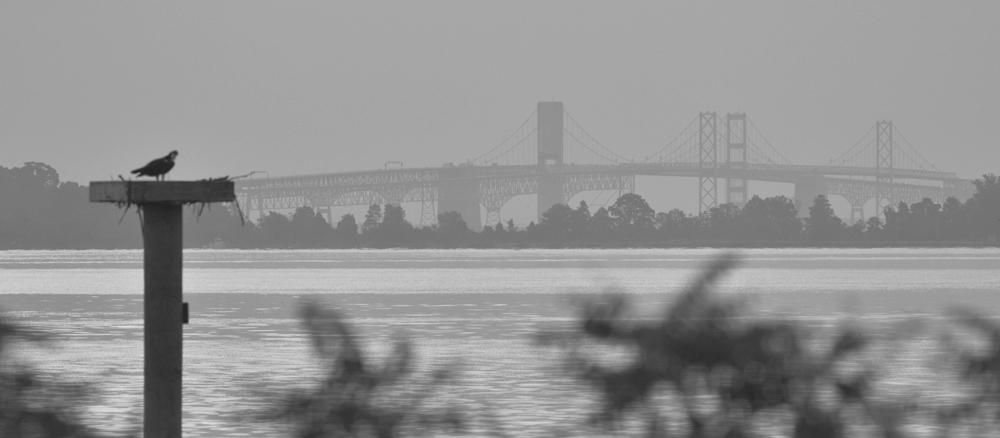
Cold and clear, just what you’d expect In early February. I was undecided where to go, so I picked Fort Smallwood because there have been some nice finds there recently. I had virtually no luck with the exception of a nice hawk, so I traveled to Thomas Point and Quiet Waters, which have been reliable lately. I found a few nice ducks, then headed home to await the dryer repairman.
Flash Gallery Featuring Ducks
Gadwalls at Thomas Point State Park
The weatherman was calling for “AM Snow” last night, so I was pleased to see a little sunshine around 9:00, and I headed out to Thomas Point to take advantage of it. I’ve been sticking close to home lately to save a little time and gas money, and it’s working out well so far.
I got a distant image of the Bald Eagle who eluded me yesterday, and I was very pleased to find a pair of Gadwalls, a duck I’ve only seen once before. After finding very few more birds, I headed over to Quiet Waters and found a few nice ducks.

From Wikipedia:
“The Gadwall breeds in the northern areas of Europe and Asia, and central North America. In North America, its breeding range lies along the Saint Lawrence River, through the Great Lakes, Alberta, Saskatchewan, the Dakotas, south to Kansas, west to California, and along coastal Pacific Canada and southern coastal Alaska.[2][4] The range of this bird appears to be expanding into eastern North America. This dabbling duck is strongly migratory, and winters farther south than its breeding range, from coastal Alaska, south into Central America, and east into Idaho, Kansas, Ohio, Virginia, and then south all the way into Central America.[2][4] Its conservation status is Least Concern.[1]

There was an early Osprey reported at Quiet Waters yesterday, but I didn’t find it. I settled for this pair of Red Breasted Mergansers.

Wikipedia:
“The Lesser Scaup (Aythya affinis) is a small North American diving duck that migrates south as far as Central America in winter. It is colloquially known as the Little Bluebill or Broadbill because of its distinctive blue bill. The origin of the name scaup may stem from the bird’s preference for feeding on scalp – the Scottish word for clams, oysters, and mussels, however, some give it credit to the female’s discordant scaup call as the name’s source.[1] It is apparently a very close relative of the Holarctic Greater Scaup or “bluebill” (A. marila), with which it forms a superspecies.[2]”
Belted Kingfisher at Quiet Waters Park
Yet another day when work took precedence over birding, but I managed a couple of hours at Thomas Point and Quiet Waters.
It was quite cold, but relatively clear with a slight wind, but the birds just weren’t around in any numbers, and very little variety. I was surprised at the relative scarcity of birds at Thomas Point, except for the continuing large flock of Canvasbacks. I missed a very nice Bald Eagle because I wasn’t paying enough attention to the trees over head.
Quiet Waters wasn’t much more productive, but a Kingfisher provided some good images.
Canvasbacks on Thomas Point Road
We had a bit of snow last night, and I thought I’d have to forgo birding today as it was quite cold and windy.
The snow stopped around 8:30, so I decided to give it a shot, and went to Thomas Point again, and also stopped at a community along the way.
The point was nearly barren, but a large flock of Canvasbacks was sheltering in a cove, and I got a few shots. Not a great day, but I got out and saw a few nice birds.
Windy with Ducks at Thomas Point
When I stepped out this morning, the weatherman had gotten it right again. There was a strong West wind with temps in the 40s,and I realized Thomas Point would be in the lee, so I went there after checking out a spot along Thomas Point Road where some Canvasbacks were resting. I managed a few good shots at the point, then headed to the grocery store for all the stuff I forgot yesterday. Afterward, I made a stop at Quiet Waters, where the West wind was working against me.
Red Breasted Mergansers at Quiet Waters
The early morning looked quite unpromising:gray, cloudy and threatening rain. I managed a few chores, and when I looked again it was much more promising, so I headed out to Thomas Point. I found a couple of interesting ducks, but the waves were high and birds were scarce, so I headed over to quiet Waters, where I found a flock of Red Breasted Mergansers and a few small birds.

The White Breasted Nuthatch is a noisy bird, so I heard this little guy long before he landed right above my head.
Forty Years ago at Thomas Point
Well, I couldn’t ask for better weather, but you have to wonder about sunny and 60 degrees at the end of January.
I started the day at Jonas Green Park, which was sparsely populated, then headed to Greenbury Point, where I found a few ducks and a distant Bald Eagle. On the way home, I stopped in to see Theresa Dearborn, on Thomas Point Road, who had showed me some old photos of ducks gathered around Thomas Point 40 years ago (Approx.), and she graciously allowed me to scan them and post them here.
Canvasbacks and More at Thomas Point State Park
The day looked very promising, with a bright sky and temps in the high 30s when I traveled to Thomas Point.
The Mergansers were still hanging out, along with Scaups and Buflleheads. After an hour or so, I decided to head for Quiet Waters, when I noticed a flock of Swans and Canvasbacks behind a private residence on Thomas Point Road. I saw a guy getting his paper, and he was kind enough to give me permission to use his back yard for a few minutes to get some photos, and it wwent well.
Thank you, John and Theresa!

Cornell:
“Along with Wood Ducks and other cavity-nesting ducks, Hooded Mergansers often lay their eggs in other females’ nests. This is called “brood parasitism” and is similar to the practice of Brown-headed Cowbirds, except that the ducks only lay eggs in nests of their own species. Female Hooded Mergansers can lay up to about 13 eggs in a clutch, but nests have been found with up to 44 eggs in them.

The ducks at Thomas Point move with the current, and they often fly short distances, presumably to return to the best feeding spot, like this Bufflehead.

I observed this Long Tailed Duck and his mate for several minutes, and I was struck by the fact that they seemed to dive in near unison.
Mergansers, Scaup and Buffleheads
The weatherman kept changing his mind, so I was surprised to see a shining Sun and decent temps this morning. I headed back to Thomas Point, with plans for a longer day, but I had to cut it short for domestic chores.
I still call myself a novice at this birding and photography business, but I’m starting to learn what a difference decent light makes.